Sunday, November 2, 2008

Symbols

Religion Symbols Religious Royalty Free Stock Photography


Symbols, how do they serve us? What are their purposes and parts in our life?
Airports, railways, roads, hospitals, schools and shops where ever you go there are symbols. Symbols are not bound by languages and they convey the same to people from different cultures easing out the communication gap.
Hinduism is replete with symbols: physical and metaphysical. They mean a lot of things very valuable. They help to keep us in close proximity to the most profound truth. These symbols are our only existing link with the ancient world.
Like the symbol “Om”, which forms the crux of every prayer and invocation - a sacred mantra referring to the all absolute, like the swastika (that lingers in our tradition even today), which denotes the omnipresence of the absolute on one hand but is same as the protective shape of fortresses on the other hand, like the ringing of the bell and blowing of the conch at the temples is to simulate the reverberance of the syllable Om, like the marks on the forehead to cool down the hot spot, like the worship of the medicinal tulasi and so on.
Had our ancestors known the things or had mastered those things which we treasure today as the lost arts, there is every chance that they had a psychological frame of mind rivaling ours or perhaps superior to us.
The divination of the forces of nature and the prayer towards them was like empowering the nature. How does it relate to today’s mundaneness? To answer near exactly, it is eco-friendliness. Eco friendliness means not polluting the air, water, earth, etc., It is essentially maintaining the balance of the eco system and the chains. Opening one’s mind and looking in to the life and the practices of our ancestors, we find a lot of logic and sense. Ancient people were masters in maintaining the serenity or perhaps they were trying to increase the same. It could not have been a fable, keeping in mind their other extraordinary achievements. The trinity, gods, goddesses, they all formed the different aspects on the circumference of the same circle. Some may find the different stories within Hinduism contradicting with each other. Of course the puranas themselves seem to contradict each other. Each story, each purana was meant to teach or imbibe something different to its reader.
It needs a little imagination and a lot of patience to understand the facts. It is just the change in perspectives of the different types of people that lived on earth either at the same time or at a different time.
For the antagonists and the skeptics: this is nothing different from our everyday scenario.
When asked to identify the entities X and Y the best things that have ever happened under the premise that X and Y must be the most important for them and the world, a biologist, a chemist, a physicist, a geologist, a politician, an engineer, a doctor and a lawyer won’t give the same answer or at least the same reasoning.
X and Y could be the Newton and Einstein for a physicist, a DNA and a cyanobacteria for a biologist, could be water and oxygen for a chemist, plates and minerals for geologists, money to pay fees and good GPA for engineers, patients and medicines for doctors, law makers and law breakers for a lawyer, people to vote and problems for people would be the choices of a politician, Hanna and Barbara for a kid.
The famous Apple could have had taken Newton’s place. A physicist before 1900’s would opt for Galileo instead of Einstein alongside Newton and that is “relativity”. Any new habitable planet, cure for cancer, aids, more efficient energy source and other new findings are going to affect these choices.
However, no one can dispute that these choices are bad or wrong. We cannot disown a single person out the lot because of the choices made, the reason is we need all of it today for a successful survival.
Just like this, the different puranas try to answer through different perspectives the same question.
Also, I feel that the perception towards religion was totally different in the ancient days from how we look at it today. And the result is reciprocation. As you sow so shall you reap?
Creation and evolution are the poles that are still to be bridged if science and religion need to be consistent with each other.
So, how did evolution occur? The answer is known to us through the immense research and intelligence. Charles Darwin was instrumental in this mammoth task of rooting backwards. The famous Theory of Evolution and Survival of the fittest are the slogans that form the crux of the high school science. Most scientists agree with that. But this had been told epochs ago and ever since then it was just absorbed to the extent that today it stands as the basic premise of the oldest way of living still prevailing on earth. There is no clear line of distinction between the Hindu way of life and their religious faith. So religion was the way our ancestors had accounted on to teach us the truth about life, the truth about the world, the universe and the ultimately the truth about our way of living. The Hindu way of life and their religion are intertwined but caution, they are not the same. The dress we wear today is the Hinduism we know today. There is no dress without the threads of Hindu way of life and the colors of religion. From the raw material to the final dress we do not know who the makers are and who are all involved in shaping it into the final product. Imagine an all compatible dress or a dress that can be changed to anything that you want (not an exchange at wal-mart!). That is what this is.
Starting from the fish, tortoise, boar, lion-man, dwarf, anger incarnate, man, super man the hierarchy teaches everything.
I perceive a few things from the incarnations and these are only my perceptions.
Life sprouted at sea. There are lots of scientific evidences pointing towards this “Myth”! When sea was home, probably land looked hostile for our ancestors. But once the plethora of food was threatened by fierce competitors juxtaposed with the life threat from the stronger predators, home sweet home became hostile and so some of our ancestors shifted to the new home, the land. Then onwards the land has been very patient to the onslaught, it has been the same to our ancestors and to us.
Slowly the evolutionary arrow guided through herbivores to the king of the jungle. The first sign of human form is a dwarf. This need not necessarily mean a dwarf but just a form close to human form but not completely human. Then this leads to the perfection in physical form but still agitated mind, not essentially violent but trapped in emotions, still away from perfection. After all, this struggle and strife must lead to perfection and there was perfection personified. Perfect in every sense: physically and mentally.
Have all of us evolved this far? No.
Evolution is not uniform and does not occur at same pace throughout the world. There were monkey kings and warriors and bears warriors in this story of the perfect human. Evolution is not something which occurs overnight.
Have we come this far? I doubt it. Most of us are given to emotions. We are yet to reach the perfection.
What comes above man? Superman. Superman has all the divine powers and can make fate work for him and decides the course of events affecting the people.
And the mistakes in gene coding and decoding every now and then results in the filling of the orbitals at the other end of spectrum and thereby need a cleansing act which is the cause of the last tithe of the incarnation to explain the evolution.
All this is symbolically, a part of the Hindu tradition.
All the protagonists of atheism and agnosticism fail to see this; rather they delibrately deny these facts.
What do you see from the incarnations? One god created all the beings and the same god comes as fish, as lion and as a superman. How are Hindus polytheists?
Apart from these, what else do we learn from the Ten? It shows the route in general taken by the nomad man to civilize in to cities. Dwarf was more of a wanderer and it took some time to settle down and lead an easy life. The nomad goes in search of food and shelter and has no constant place of residence, while the perfect man knew how to rule people, organize and manage the people at one place. Then man took to agriculture and this might even be symbolized by the plough in the hand. It shows how to socialize and live harmoniously as a peaceful society and also at every step along with all these symbols, there are stories show how not to also. And when man becomes too possessed with the land which has given him refuge from the hostile, it ultimately leads to war. All these are symbolically implicit in the most revered form. Many antagonists fail to accept the fact that there were people before us who were more intelligent than us. There could have been people who predicted the evolution thousands of years before Darwin can actually think about this.
There are many more symbols to be understood carefully and enjoyed . May be some one already did or will. I haven’t got the wisdom and patience yet to look at them in the right perspective.

Saturday, June 14, 2008

Time I am....


Not many of us know, even an iota of what is being passed down the generations in the form of the sacred Vedas. Many of us do not even know what the Vedas imply. Whatever we claim to know have come from lending our ears to other people's talk of whom we know very little or most of the times their authority over the Vedas is very much questionable. Second and the most important source are the books. Common man's knowledge is very much limited at least with respect to the scriptures. And it is widely believed and claimed as true and is attributed to the fact that the scriptures are written in a highly arcane alien language called "Sanskrit" which no one can understand. Of course it is true that the scriptures are mostly in Sanskrit, but it is not a language which no one can understand but the truth is that no one wants to understand because no one has to. Had the mother tongue of United States of America been Sanskrit or that of China there is profit in shelling out money to learn it but what good does learning Sanskrit for scripture deciphering do to a common man in meeting his everyday needs?
And if at all, when a common man gets to lay his hands on some commentaries on the arcane scriptures, he gets the essence of the message conveyed in a pejorative sense. Why? Because most of the commentaries in the easily understood language (English) by the highly acclaimed western historians. And I have already expressed the credibility of such commentaries in the previous threads.
When I started to write this, I questioned my authority and felt belittled, but later, I realised the necessity to continue writing at least to share my knowledge and understanding with you guys.
The present plight of Sanskrit as a language just reminds me of the plight of the language English in the novel Time Machine by H. G. Wells. This was depicted very well in the movie by the same name starring Guy Pearce.


Guy Sormon, the author of genius of India states," Temporal notions in Europe were overturned by an India rooted in eternity. The Bible had been the yardstick for measuring time, But the infinitely vast time cycles of India suggested that the world was much older than anything bible spoke of. It seems as if the Indian mind was better prepared for the chronological mutations of Darwinian evolution and astrophysics."
So what is the time scale according to the Vedas? Where are we? How much mature creations are we?
The time cycles are infinitely vast as quoted by Sormon.
Every time unit can finally be concocted to the lifetime of Brahma, one of the trinity gods who is in charge for creation. But where does he come from?
Brahma has a birth also. He is born from the eternal god, Lord Vishnu who is unchanging with time. "Time I am...."
Lord Brahma is seated on the lotus blossoming from the navel of lord Vishnu. Is this an allegory of the Big Bang? Universe is expanding from a single spot following the Big Bang. Is that single point the navel of Vishnu and can the universe be compared to Brahma on the lotus? If true, then there can be more than one universe leading unto the theory of multiverses. Of course, the navel is the sprouting place of new life!
Now Brahma lives for 100 years and then dies and is reborn again and this process continues forever. Thus, this universe is bound to implode after expanding for quite long time while Vishnu is going to be unchanging ( my inference). 100 years of Brahma's life time has a totally different meaning when compared to 100 years of a normal man's life time.
Kalpa, Manvatara, Mahayuga, Yugas are the different terms that we will encounter from here.
A Kalpa refers to one day of Brahma and one night of Brahma is as long as one day. One day of Brahma has 14 Manvantaras and a night is equally long. But during night Brahma is supposedly sleeping. Each manvantara is 71 Mahayugas long and each Mahayuga is a collection of the four yugas: Satya, Treta, Dwapara, and Kali. The life span of humans changes with every yuga.
1 Kali Yuga is 432000 solar years which are 10 % of the lenght of a Mahayuga. So, one Mahayuga is 4320000 solar years.
Solar/Human Years Life time (years)
1 Satya Yuga - 1,728,000 100,000
1 Treta Yuga - 1,296,000 10,000
1 Dwapara Yuga - 864000 1000
1 Kali Yuga - 432000 100
Now calculating the life time of Brahma in terms of the human life time,
1 Mahayuga is 4,320,000 years and 1 Manvantara has 71 Mahayugas ==>
1 day of Brahma has 994 Mahayugas.
In each Brahma's day there are fourteen Manus (patriarchs of mankind).After the dissolution of every Manu a new Manu comes. With the change of Manu the universal management also changes. Vedas also describe about a kind of transition periods between Manvataras which are as long as 4 yugas.Each manvantara periods ends with a partial devastation and starts with a partial recreation of the universe.
So 1 day of Brahma = 994 Mahayugas + 60 Yugas => 1000 Mahayugas = 4,320,000,000 years.
1 night + 1 day = 8,640,000,000 years (8.64 billion years).
We live in Kali-yuga of the 28th Maha-yuga of the 7th Manvantara(vaivashatha) of the 12th kalpa
(called Sveta-Varaha), in the 51th year of Brahma. The beginning of this kalpa was 2.3 billion years ago (453 mahayugas back).
The life span of Brahma is identical with the duration of the universe. This time span, called a maha-kalpa, is also the duration of one breathing in and out of Maha-Vishnu, the Personality of Godhead. Maha-Vishnu lies down within the ocean of causality and sleeps. He is eternal, and He dreams the material world in His cosmic slumber. When He exhales, all the universes emanate from the pores of His skin, and a Brahma is born within each universe. When He inhales, Brahma dies, and He sucks the universes into His mouth and destroys them. With each exhalation, the entire process starts anew. This cycle goes on eternally and is therefore also called eternal time.
There are 360 days in a year for Brahma and we are in the first day of 51st year.
So far 360 x 50= 18000 days have passed for Brahma
This is equivalent to 18000 x 2000 x 4320000 Human Years
In other words 155,520,000,000,000 Human Years.
So its been 155,522 billion years since the formation of universe and still the same time to go for the collapse of the universe to come while modern science predicts the present age as jst 15-25 billion years.
From the first chapter of Surya-Siddhanta, the most revered authoritative source of Hindu astronomy, we have the following passage:
11. that which begins with respirations (prana) is called real…….Six respirations make a vinadi, sixty of these a nadi:
12. And sixty nadis make a sidereal day and night. Of thirty of these sidereal days is composed a month; a civil (savana) month consists of as many sunrises;
13. A lunar month, of as many lunar days (tithi); a solar (saura) month is determined by the entrance of the Sun into a sign of the zodiac; twelve months make a year. This is called a day of the gods.
14. The day and night of the gods and of the demons are mutually opposed to one another. Six times sixty of them are a year of the gods, and likewise to the demons.
15 & 16. Twelve thousand of these divine years are denominated a chatur-yuga; of ten-thousand
times four hundred and thirty two solar years is composed that chatur-yuga, with its dawn and
twilight. The difference of the krita-yuga and the other yugas, as measured by the difference in the number of the feet of virtue in each is as follows:
17. The tenth part of a chatur-yuga, multiplied successively by four, three, two, and one, gives the length of the krita and the other yugas: the sixth part of each belongs to its dawn and twilight.
18. One and seventy chatur-yugas make a manu; at its end is a twilight which has the number of years of a krita-yuga, and which is a deluge.
19. In a kalpa are reckoned fourteen manus with their respective twilights; at the commencement of the kalpa is a fifteenth dawn, having the length of a krita-yuga.
20. The kalpa, thus composed of a thousand chatur-yugas, and which brings about the destruction of all that exists, is a day of Brahma; his night is of the same length.
21. His extreme age is a hundred, according to this valuation of a day and a night. The half of his life is past; of the remainder, this is the firsts kalpa.
22. And of this kalpa, six manus are past, with their respective twilights; and of the Manu son of Vivasvat, twenty seven chatur-yugas are past;
23. Of the present, the twenty eighth chatur-yuga, this krita yuga is past……..
For more reading you can go to...
http://veda.wikidot.com/kala-chakra
One another description from Bhagavatham based on atom spacing:
The atomic description of the Srimad Bhagavatam is almost the same as that of modern science. This is further described in the Paramanu-vada of Kanada. Time is measured in terms of its covering a certain space of atoms. Standard time is calculated in terms of the movement of the sun. The time covered by the sun in passing over an atom is calculated as atomic time.

During the period of one month the moon wanes and is called krishna-paksha, the dark moon or amavasya. In the same month the moon waxes and is called shukla-paksha, the full moon or purnima. Thus purnima to amavasya is called krishna-paksha (dark moon) and amavasya to purnima is called shukla-paksha (bright moon). Two months equal one season. During the first six months the sun travels from south to north (uttarayana). During the second six months the sun travels from north to south (dakshinayana). Two solar movements equal one day and night of the demigods.
For more reading:
http://www.veda.harekrsna.cz/encyclopedia/time.htm
So, the time scales mentioned in Vedas go from respirations and atoms to billions and beyond imaginations. How ingenious and brilliant must have been a mind to even imagine and think of such a large time line with so much accuracy?
So what conclusion does it lead to?
I see no conclusion but it only increases my hunger.
I watched all the episodes of Cosmos by the famous Astro-Physicist Carl Sagan. He talks about things that we cannot imagine: about parallel universes, fourth dimension and so on……… It is an amazing piece of documentary. In there, he quotes in the 6th part, “The Hindu religion is the only one of the world’s great faiths dedicated to the idea that the Cosmos itself undergoes an immense, indeed an infinite, number of deaths and rebirths. It is the only religion in which the time scales correspond, to those of modern scientific cosmology. Its cycles run from our ordinary day and night to a day and night of Brahma, 8.64 billion years long. Longer than the age of the Earth or the Sun and about half the time since the Big Bang. And there are much longer time scales still.”

Sunday, May 25, 2008

Ranga.. on the go.........


image:http://www.atmajyoti.org/images/srirangam-gopuram.jpg


Nostalgia is universal but how is that feeling that is always with you irrespective of time, place, the sublime shrinking world and everything else that can mesmerize and even potentially destroy nostalgia! called? Perhaps it can be called as “eternalgia”. Well I am not coining words but I do not know any word that would describe such a feeling. Eternalgia is common with everyone but only the level of eternalgia changes from one individual to another.
Amidst all common life activities, God and Temples form the crux of duty for everyone back in India. Well, some may argue that life is changing. Yes I agree, but still God and Temples are important for most people (atleast for favors if not for devotion). The God still seems to answer the prayers.
Well, I grew up in one of the important religious centers of south India, Srirangam and I atleast know how this God plays a vital role in the activities of the city. The temple is supposedly the largest functioning Hindu temple in the world with seven prakaras around it and different gopurams at various axial positions. The prakaras are the different tiers, outer ones of which now form the residential and market complex. Gopurams are the towers that are present in different locations in different sizes. The tallest gopura (235 ft) in the front called the Rajagopuram is the tallest temple tower in Asia. The very sight of the Rajagopuram is considered auspicious and holy and evokes prayers from the travelers in buses and trains. All businesses and activities here prosper along with the temple.
From mendicants to millionaires, the rule of life is simple, “prayers and duties” (there may be exceptions).
The way to the temple is lined on either side with shops: shops selling offerings (fruits, beetlenut leaves, coconut, camphor, flowers), shops for the residents of Srirangam, shops for tourists, eateries etc.,
This slowly paves way to the next tier welcoming us with a gopuram entrance. As we go towards the sanctum we see a number of shrines for gods, saints and devotees……………..
During my days at Srirangam, going to the temple was like an everyday duty, a ritual I could not miss; sometimes with my parents and sometimes with friends. Among my friends, a guy, sriram introduced me to the great book called “Tiruvarangan Ula”: The travel of Ranga. This book was all about the temple at srirangam and the events that happened around it in the 14th century. He had already read that book twice before he told me in detail about the lucidity of writing and the stunning truths about the temple which most of us do not know. It instilled in me a desire to get a copy for myself and enjoy its warmth.
I did get my copy a few months later and started reading it with full vigor and superfluous interest.
The story is all set in the 14th century and it is all about how the God at srirangam is protected from the mohammadean conquerors during the period of khiljis and tughlaqs. It is all about the devotion of the people of srirangam at that time who revered Lord Ranga not only as God but as their own king who rules the whole world from the seat at srirangam. It is about the fleeing of the residents of srirangam from their houses carrying lord Ranga to protect him from the conquerors hands.
The northern parts of India were very often exposed to all kinds of conquests by foreigners and to bloody wars. The south had its own trouble of smaller warring kingdoms most of the time. Of course the southern part had its own share of big kingdoms but the rulers were not foreigners but one of their own blood. Very rarely did the conquerors from north show interest in capturing the southern parts of India. One such instance was in the 14th century when the Hoysalas and Pandyas were the puppets of Khiljis and Tughlaqs. During this conquest, the idol at srirangam, revered as Lord Ranga was forcefully taken to Delhi. But how can the people of srirangam go without a king? So they decided to get back the idol. A group of dancers from srirangam pleased the ruler of Delhi somehow and got the idol back. There is also an offshoot to this story that the daughter of the king was so attached to the idol that she fell sick as soon as the idol was taken from her and finally died unable to find the idol. There is a shrine for that devoted girl in the temple of srirangam, very close to the sanctum.
The next conquest came in a very short time after the first. Forty years later, Mohammad Bin Tughlaq and his army seiged the gates and walls of srirangam to plunder the temple. This time the residents of srirangam and the devotees of Lord Ranga did not want him in the alien hands. They protected the bigger immovable valuable assests of temple by behind the walls and below the ground. The biggest risk lay with the utsavar idol. Feeling that they could not give enough protection for lord Ranga inside the temple, the chiefs of the temple left the temple along with the utsavar and thus started the great journey. For the next fifty odd years the omnipresent was hidden and protected from the Moslems in search of the same.
There was desperation in the Moslem camps. They badly wanted to lay their hands on the idols, especially Lord Ranga.
But why were the Moslems after the idols?
There have been several temple demolitions and idol desecrations throughout the history of moslem rule in India. There were several instances of such happenings which are not accounted at all. This was one of the very few, the most famous being the Somnath temple desecration and looting. The rationale and logical reasoning for the motives behind all these actions are given beautifully in the book “Vandhargal Venrargal”, again introduced to me by the same sriram: primary reasons being gold, jewels and idol worship. The later conquest in certain contexts is related to the first one, owing to the idol mesmerizing the emperor’s daughter. Also, Idol desecration was one of their main goals owing to the semblance of some of the idols here to the ones at their sacred place!? I am not discussing that here
Going back again to Lord Ranga, he was not just an idol to the people here but he was their symbol of hope, their beliefs, moral. He was the symbol of their life, civilization and culture. He was their King and he was everything for them. The residents of srirangam had already scattered to the villages that were around the temple cursing themselves for not being able to save Lord Ranga.
Starting from Srirangam, the places to which Lord Ranga was taken were Azhagar Koil, Madurai, Ettayapuram, Aazhvar Tirunagari, Nagercoil, Trivandrum, Kollam, Kozhikode, Sathyamangalam and finally into the forests of Tirupati hills. All these were under the rule of Moslems who were scouting their troops looking for this idol. Again, many idols had to be kept hidden but the devotees of Ranga felt that it was just not right on their part to leave their king without proper attention. They did not want to get separated from him.
At first the Hoysalas tried to offer help to free the temple, but that resulted only in their clan destruction. It was only after a long period of time, the great Vijayanagara kingdom came in to being and the early rulers of Vijayanagara reinstated Lord Ranga back at the temple after defeating the sultans at Madurai decisively at a war.
The story also states that Lord Ranga was also taken to the battle field along with the army to oversee the happenings of the war: like a king. But the lemma in reinstating the idol after bringing the idol back to the temple after the victory is one more touching story.
In the middle of 16th century, the Nayakars at Tanjore and Madurai became independent from the Vijayanagara kingdom. The three kingdoms have done a great deal of good for the temple during the difficult periods.
Swami Vedanta Desika needs a special mention. He was one of the greatest devotees of the Lord Ranga and one of the greatest gurus for people who seeked him. He played a vital role in the temple affairs, he saved the sons of the sudarshana bhattar from the conquering hands, he erected the wall at the sanctum and he was one of the four people who had lived throughout to witness all these events and pass on to the next generation, the saga and Ranga. The four people: One was Lord Ranga himself, two was Swamy Desikan and to know about the third and fourth individuals involved in the saga, you need to experience the events from the book.
The book is written expertly with the right combination of truth and fiction in a heart rendering way.
I bought the book from Srirangam but I came to know from various sources that the book is available at Higginbotham’s book shop at Chennai. The Story is in Tamil (only Tamil), four volumes (books) and is written by the famous writer Pushpa Thangadurai in the name of Sri Venugopalan.
Its been a few years now since I read the novel but hoping to read it again soon.
May Lord Ranga Bless us.

Sunday, February 17, 2008

The Gupta Gamble


This was what I didn't want to happen, the longest episode, "the lay off period". But beleive me I was really caught up with several things that needed immediate attention. Now lets only hope that this doesnt repeat.This means no promises.


The period between 335 - 380 AD supposedly forms some of the important years of the Indian history, perhaps the world history. The Gupta age is called the Golden Age of Indian history. May be this forms a relatively the lesser number of years compared to the the total reign of Gupta dynasty 320 - 550 AD but the conquests made by Samudragupta, who was the Gupta emperor during this period were numerous and have earned him a title which is what shows how the Indians have accepted without the slightest shame, the western interpretation of Indian history. Samudragupta was the able successor of Chandragupta I. Chandragupta I was the first succesful of the great Gupta Empire. During the Samudragupta reign, the empire stretched from Himalayas to Narmada to Brahmaputra. He made no attempt to incorporate the kingdoms of south of Narmada and Mahanadi rivers (southern India) into his empire. When he died his mighty empire bordered with Kushan of Western province (modern Afganistan and Pakistan) and Vakatakas in Deccan (modern southern Maharashtra). Samudragupta was a staunch Hindu, a devotee of Lord Vishnu and after all his military triumphs, he performed the Ashwamedha Yagna (Horse sacrifice ceremony) which is evident on some of his coins. Ashwamedha Yagna gave him the coveted title of Maharajadhiraj, the supreme king of kings. His greatest achievement can be described as the political unification of most of the India or Aryavarta into a formadible power.

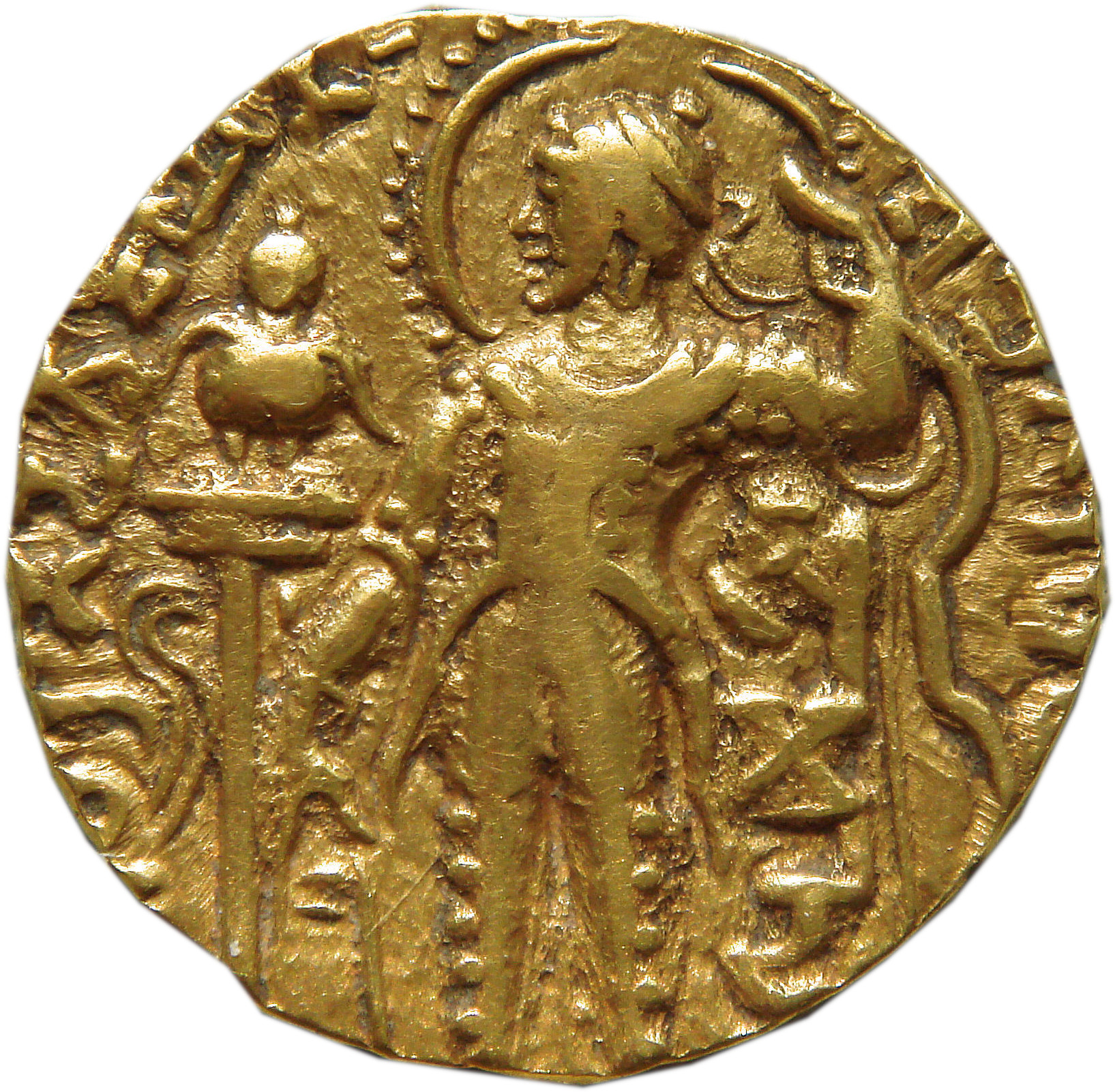
Samudragupta, inspired by the Kushana monetary system, for the first time made the Gupta gold coins. Kushanas themselves were inspired by the Roman coins. Samudragupta was a great military general, but apart from that, his personal accomplishments are equally remarkable. He fostered a number of poets and scholars and religious, literary and artistic aspects of the rich culture. He had a huge interest in music and musicians and his interest in music can be attributed to the fact that he himself is a very good Veena player. Following the rule of samudragupta was another prosperous reign, the reign of Vikramaditya.

Such is the greatness of Samudragupta and the Gupta dynasty.

Now let me briefly retell the story of one of the greatest generals this world has seen. 1769-1821 AD. From the mediterranean island Corsica, through his military exploits and ruthless efficiency, from obscurity Napolean became the emperor of France, Napolean I. He has also been portrayed as a power hungry conqueror. Napoleon denied those accusations. He argued that he was building a federation of free peoples in a Europe united under a liberal government. In the states he created, Napoleon granted constitutions, introduced law codes, abolished feudalism, created more efficient governments and fostered education, science, literature and the arts. The exploits of Napolean are well known from Corsica to Elba to Waterloo and finally to St.Helena.

Now, the irony lies in the title as I said earlier, the title conferred to Samudragupta by the western historians. "Napolean of India" , this is how Samudragupta was titled and there is reason why the west annointed Samudragupta thus but why should we, the people of India consider this misnomer as annointing. Napolean lived almost 1400 years after Samudragupta and it would make sense if he was called as the " Samudragupta of Europe". But it is not the case and we have been rendered insensitive to the extent that so many years after freedom we still continue to teach in our schools the same old thing that the west forced on us and if any change is made to make it look right then it is instantaneously termed as " Saffronization". This is one only one instance that we can spot out glaringly but I strongly beleive that there are several other such instances of "Glorified west and disparaged India". Wake up, its time we stop teaching the false history of our own great India.

http://en.wikipedia.org/wiki/Samudragupta
http://en.wikipedia.org/wiki/Napoleon_I_of_France

Quodos

வெள்ளைப் பூக்கள் உலகம் எங்கும் மலர்கவே!

விடியும் பூமி அமைதிக்காக விடிகவே!

மண்மேல் மஞ்சள் வெளிச்சம் விழுகவே!

மலரே சோம்பல் முறித்து எழுகவே!

குழந்தை விழிக்கட்டுமே! தாயின் கத கதப்பில்,

உலகம் விடியட்டுமே! பிள்ளையின் சிறுமுகச்சிரிப்பில்

-Vairamuthu