


This was what I didn't want to happen, the longest episode, "the lay off period". But beleive me I was really caught up with several things that needed immediate attention. Now lets only hope that this doesnt repeat.This means no promises.
The period between 335 - 380 AD supposedly forms some of the important years of the Indian history, perhaps the world history. The Gupta age is called the Golden Age of Indian history. May be this forms a relatively the lesser number of years compared to the the total reign of Gupta dynasty 320 - 550 AD but the conquests made by Samudragupta, who was the Gupta emperor during this period were numerous and have earned him a title which is what shows how the Indians have accepted without the slightest shame, the western interpretation of Indian history. Samudragupta was the able successor of Chandragupta I. Chandragupta I was the first succesful of the great Gupta Empire. During the Samudragupta reign, the empire stretched from Himalayas to Narmada to Brahmaputra. He made no attempt to incorporate the kingdoms of south of Narmada and Mahanadi rivers (southern India) into his empire. When he died his mighty empire bordered with Kushan of Western province (modern Afganistan and Pakistan) and Vakatakas in Deccan (modern southern Maharashtra). Samudragupta was a staunch Hindu, a devotee of Lord Vishnu and after all his military triumphs, he performed the Ashwamedha Yagna (Horse sacrifice ceremony) which is evident on some of his coins. Ashwamedha Yagna gave him the coveted title of Maharajadhiraj, the supreme king of kings. His greatest achievement can be described as the political unification of most of the India or Aryavarta into a formadible power.
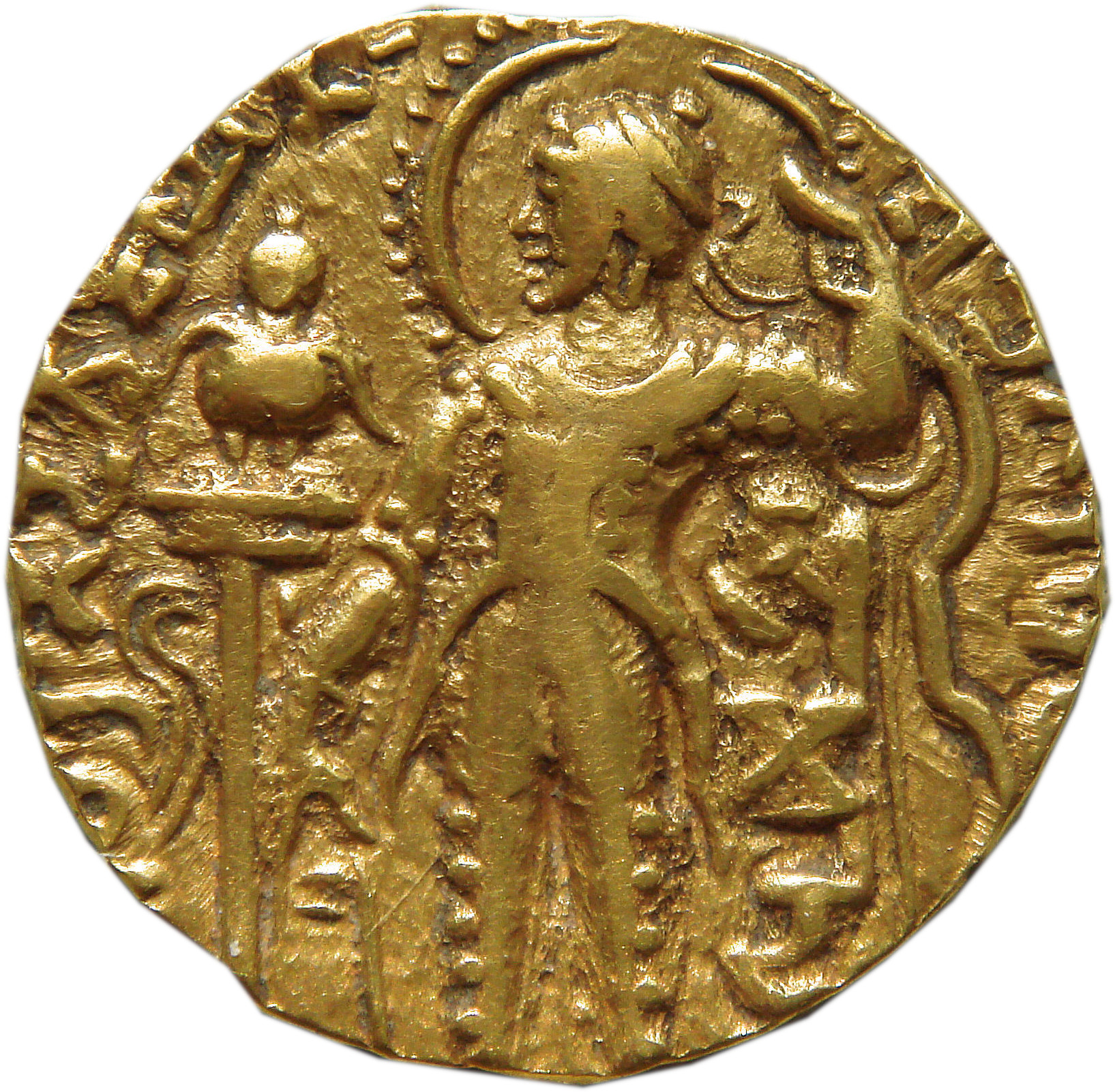
Samudragupta, inspired by the Kushana monetary system, for the first time made the Gupta gold coins. Kushanas themselves were inspired by the Roman coins. Samudragupta was a great military general, but apart from that, his personal accomplishments are equally remarkable. He fostered a number of poets and scholars and religious, literary and artistic aspects of the rich culture. He had a huge interest in music and musicians and his interest in music can be attributed to the fact that he himself is a very good Veena player. Following the rule of samudragupta was another prosperous reign, the reign of Vikramaditya.
Such is the greatness of Samudragupta and the Gupta dynasty.
Now let me briefly retell the story of one of the greatest generals this world has seen. 1769-1821 AD. From the mediterranean island Corsica, through his military exploits and ruthless efficiency, from obscurity Napolean became the emperor of France, Napolean I. He has also been portrayed as a power hungry conqueror. Napoleon denied those accusations. He argued that he was building a federation of free peoples in a Europe united under a liberal government. In the states he created, Napoleon granted constitutions, introduced law codes, abolished feudalism, created more efficient governments and fostered education, science, literature and the arts. The exploits of Napolean are well known from Corsica to Elba to Waterloo and finally to St.Helena.
Now, the irony lies in the title as I said earlier, the title conferred to Samudragupta by the western historians. "Napolean of India" , this is how Samudragupta was titled and there is reason why the west annointed Samudragupta thus but why should we, the people of India consider this misnomer as annointing. Napolean lived almost 1400 years after Samudragupta and it would make sense if he was called as the " Samudragupta of Europe". But it is not the case and we have been rendered insensitive to the extent that so many years after freedom we still continue to teach in our schools the same old thing that the west forced on us and if any change is made to make it look right then it is instantaneously termed as " Saffronization". This is one only one instance that we can spot out glaringly but I strongly beleive that there are several other such instances of "Glorified west and disparaged India". Wake up, its time we stop teaching the false history of our own great India.
http://en.wikipedia.org/wiki/Samudragupta
http://en.wikipedia.org/wiki/Napoleon_I_of_France


 Posts
Posts


1 comments:
good one machi..
Post a Comment